
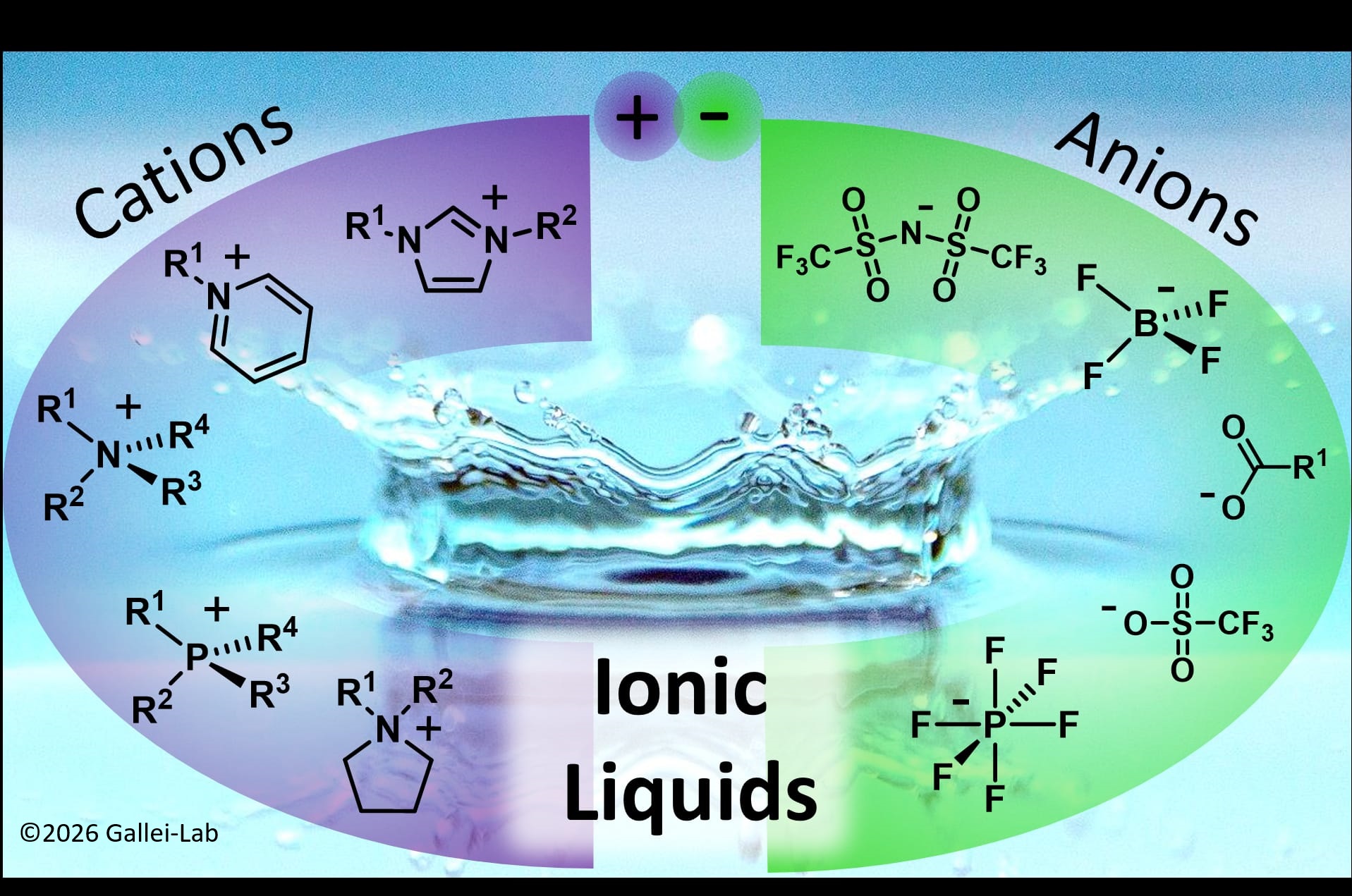
Ionic liquids are organic salts with exceptionally low melting points, commonly below 25 °C, forming a fascinating and versatile class of modern high-performance liquids.
They combine beneficial properties of molecular solvents and conventional molten salts, resulting in unique physicochemical characteristics such as negligible volatility, non-flammability, intrinsic conductivity, and excellent thermal, chemical, and electrochemical stability.
A key advantage of ionic liquids is the possibility to tailor their properties through rational molecular design. By modifying cationic, anionic, or functional structural motifs, ionic liquids can be optimized for highly specific applications ranging from electrochemical energy storage to sustainable processing technologies.
Research
Our research focuses on the application-oriented design, synthesis, and optimization of ionic liquids and ionic liquid-derived materials.
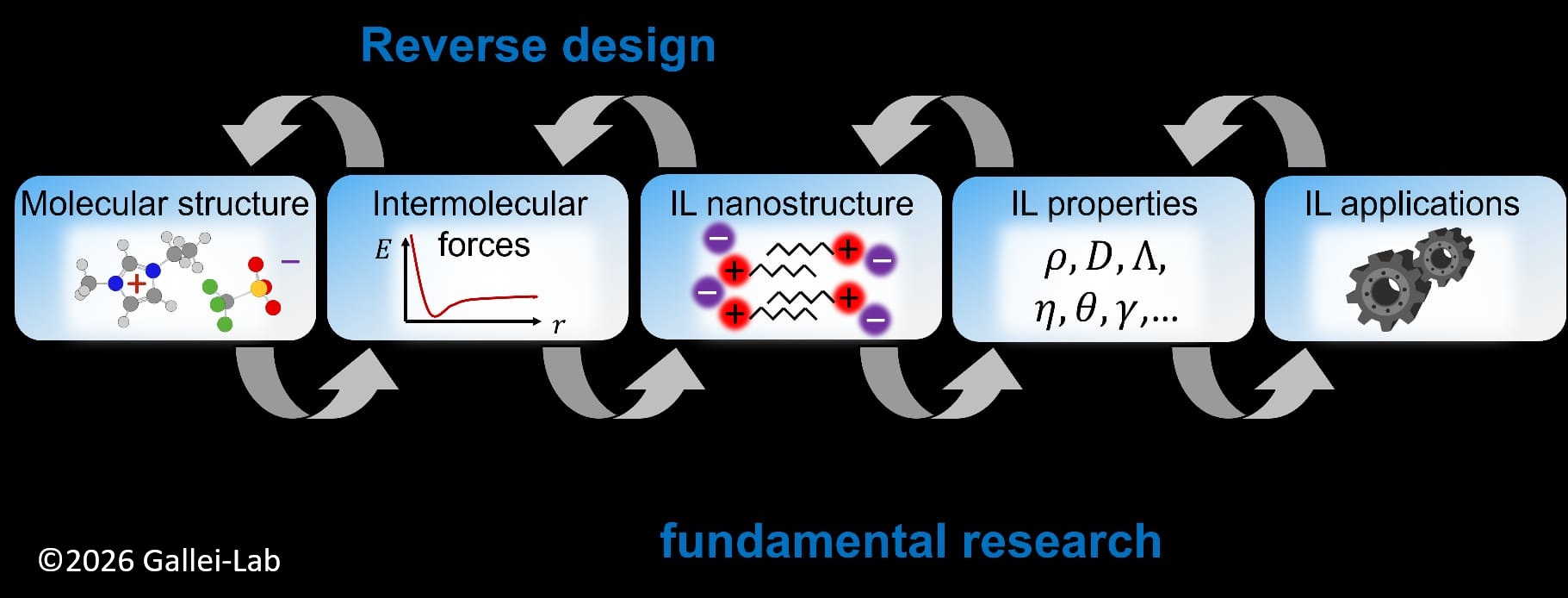
One major research direction addresses structure–property relationships. We synthesize novel ionic liquids with systematically varied cations, anions, and functional groups and correlate their molecular structures with macroscopic material properties.
A particular focus lies on maximizing ionic conductivity, which is essential for advanced electrochemical devices such as supercapacitors and rechargeable batteries. These systems are key technologies for the transition toward sustainable energy storage and conversion.
Beyond transport properties, we investigate fundamental aspects of ionic liquid behavior, including liquid nanostructure formation, intermolecular interactions, and interfacial processes with polymers and solid materials.
In addition, we develop ionic liquid-derived functional materials such as poly(ionic liquids), ionogels, hydrogels, and heteroatom-containing carbon materials generated through ionic liquid pyrolysis.
A second important research direction is the reverse engineering approach, where ionic liquids are specifically designed for targeted scientific or technological applications in close collaboration with external research partners.
We maintain close interdisciplinary collaborations with research groups working in:
- Polymer materials
- Battery technology
- Supercapacitors
- Fuel cells
- Dissolution, separation, and purification of gases
- Tribology
- Utilization of renewable resources (lignin and cellulose)
- Spectroscopy
Exemplary references:
- S. Khan, V. Rooni, D. Rauber, N. Sjulander, M. Gallei, C.W.M. Kay, S. Shanmugam, T. Kikas. Maximizing Populus tremula biomass conversion: synergistic pretreatment effects on sugars release and lignin recovery. Bioresour. Bioprocess. 2026, 13, 54.
- S. Koutsoukos, F. Philippi, D. Rauber, D. Pugh, C.W.M. Kay, T. Welton. Effect of the cation structure on the properties of homobaric imidazolium ionic liquids. Phys. Chem. Chem. Phys. 2022, 125 (10), 2719-2728.
- D. Rauber, F. Philippi, D. Schroeder, B. Morgenstern, A.J.P. White, M. Jochum, T. Welton, C.W.M. Kay. Room temperature ionic liquids with two symmetric ions. Chem. Sci. 2023, 14, 10340-10346.
- D. Rauber, F. Philippi, J. Becker, J. Zapp, B. Morgenstern, B. Kuttich, T. Kraus, R. Hempelmann, P. Hunt, T. Welton, C.W.M. Kay. Anion and ether group influence in protic guanidinium ionic liquids. Phys. Chem. Chem. Phys. 2023, 25, 6436-6453.
- X. Li, Z. He, Z. Liu, Y. Chen, Z. Zhou, G. Chen, W. Qi, D. Rauber, C.W.M. Kay, P. Zhang. High-performance post-treatment-free PEDOT based thermoelectric with the establishment of long-range ordered conductive paths. Chem. Eng. J. 2023, 454, 140047.